FNM 0265.03
Spotlight on: Jane Marcet
Laura Sharpe, Museum Director, June 2026
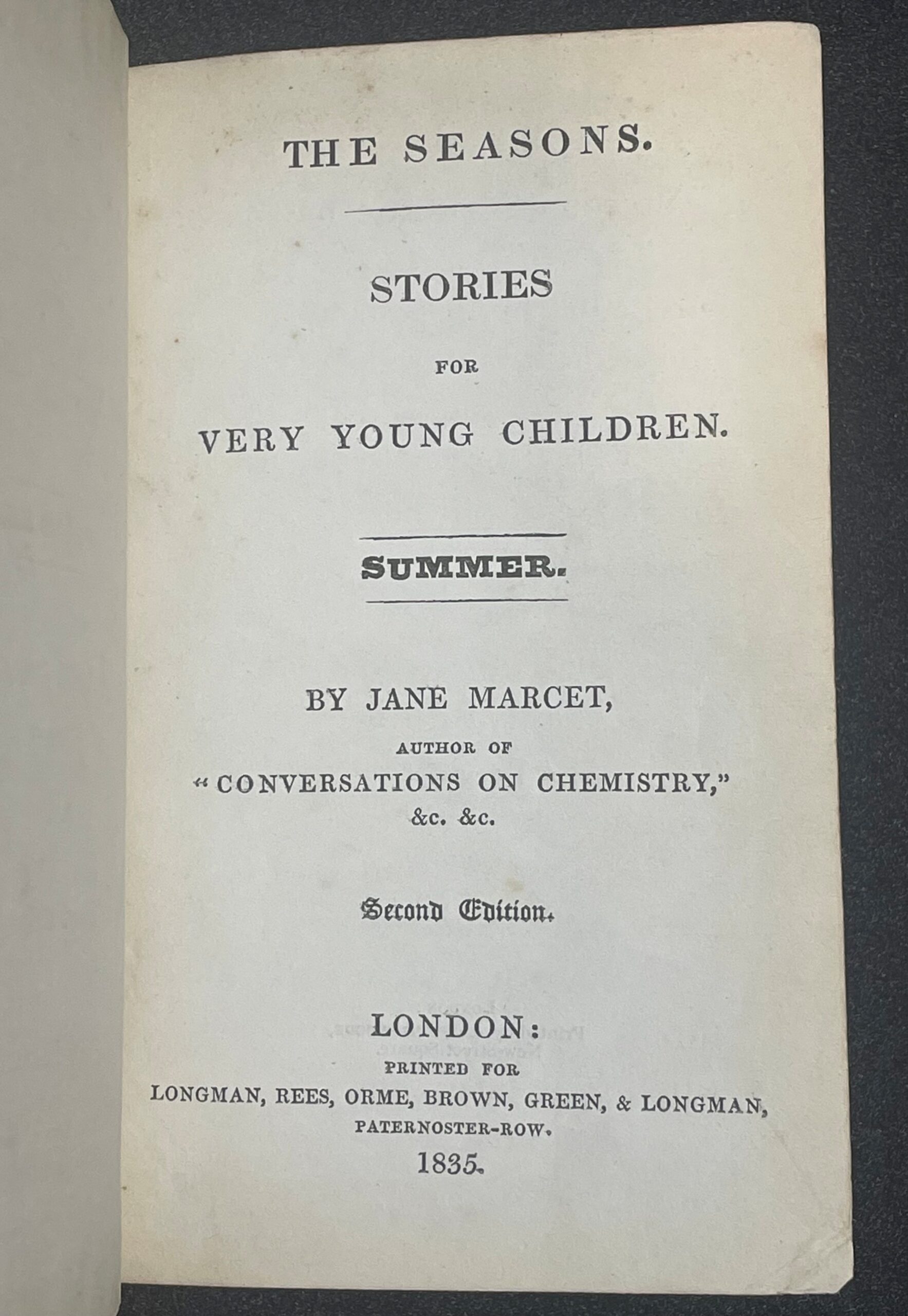
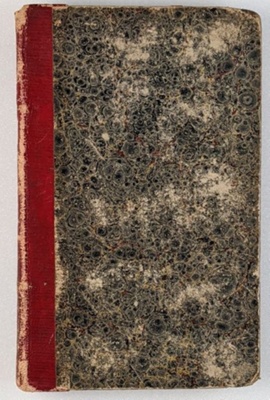
In our collection, we hold three children’s books that belonged to the Nightingale family entitled The Seasons: Stories for Very Young Children. The three volumes in our collection are Volume 1: Winter, Volume 2: Spring and Volume 3: Summer (FNM 0265.01-03). At first glance they are rather typical of children’s books of the time, uniform card covers and no bright illustrations like we have come to expect of books aimed at young children today. But it is the authors name that makes these such stand out objects, Mrs Marcet.
Mrs Jane Marcet is arguably one of the most important figures in advancing women’s scientific education in the 1800s, whilst we hold copies of her children’s books, it was her writings aimed at adult audiences that make her so significant.

Edgar Fahs Smith Collection (University of Pennsylvania)
Jane Marcet was born Jane Haldimand on the 1st January 1769. Born in London to a wealthy Swiss banking family, Jane was one of 12 children. Jane and her siblings benefited from their father’s Swiss heritage which had given him a very progressive outlook on education, valuing learning for all his children- regardless of gender. Jane’s education was unusually broad for a girl in eighteenth century England, rather than being limited to traditional ‘feminine’ subjects, she studied subjects such as Latin, History, Chemistry and Biology alongside her brothers.
At just 15 years old Jane took over managing the household after her mother’s death. This role included assisting her father with hosting his regular dinner parties, guests at these included key literary and scientific figures giving Jane regularly opportunities to converse with some of the best minds of the era. Included in these guests was Swiss political exile and physician, Alexander John Gaspard Marcet who regularly engaged Jane in scientific discussion.
In 1799 Jane and Alexander Marcet married, he remained very supportive of her continued education and the two would often attend lectures and surround themselves with fellow intellectuals. After her father’s death, Jane and Alexander received a large inheritance that allowed Alexander to quit his job as a physician and instead focus on chemistry full time. The pair even installed a laboratory in their home.
Jane Marcet recognised the importance of learning through conversation so began developing a new sort of scientific textbook, written just like a conversation between a teacher, Mrs B, and two female students with suggested experiments that could be conducted at home. The first published book in this series was Conversations on Chemistry the first edition was published anonymously in 1806 and in total 16 subsequent editions were published, the last when Marcet was 84 years old. Marcet wrote in the conversational style to explain abstract ideas in a friendly way- something she felt was more suited to women who had not received formal scientific education. The series soon expanded with Marcet also publishing these conversational books about Political Economy and Natural Philosophy, she also began writing educational books for younger children focusing on Nature and Grammar.
Whilst the dialogue between the book is between women, we know these books also had readership in the working-class male population, who would also have been less likely to receive formal education. One extremely high profile fan of Marcet is Michael Faraday, son of a Blacksmith with no formal education who would eventually become one of the most influential scientists in history. After Marcet’s death in 1858 Faraday wrote to his friend M. De la Rive describing Marcet as ‘my first instructress’.
But why do we hold copies of her children’s books here at the Florence Nightingale Museum?
FNM 0265.03
Whilst there is no evidence of any correspondence between the Nightingale and Marcet families the existence of these children’s books suggest that at least one member of the family had an interest in this highly unusual author. The books came to the museum from the Nightingale family home, Lea Hurst, along with a number of other objects. The copies we hold were published between 1835-1839, when both Florence and Parthenope were teenagers, far beyond the target age of these ‘stories for very young children’. So whilst it remains a mystery which member of the family these booked belonged to, it makes sense that the Nightingale family would be supporters of Marcet and her work. The similarities between the families are notable, both were proactive in the education of daughters in a time this was not the norm, both were active abolitionists to the slave trade and were very pro the advancement of women’s rights.
The books are not currently on display but further information can be found on ehive:
The Seasons: Stories for Very Young Children – Winter Vol.1; Mrs Jane Marcet; 18… | eHive
The Seasons: Stories for Very Young Children – Spring Vol. 2; Mrs Jane Marcet; 1… | eHive
The Seasons: Stories for Very Young Children – Summer Vol. 3; Mrs Jane Marcet; 1… | eHive
Suggested further reading:
Marcet, Jane; Conversations on Chemistry: In Which the Elements of that Science Are Familiarly Explained and Illustrated by Experiments [multiple versions available]