Spotlight on: Embley Park
Sarah Spencer-Adams, museum volunteer
Florence Nightingale was born on 12th May 1820 in Florence, Italy, during her parents, William & Frances (known as Fanny), lengthy three-year honeymoon. Their family home was Lea Hurst located near Matlock in Derbyshire.
In 1825, when Florence was aged 5, William Nightingale sought a second home; he headed south and purchased the Embley Park estate situated in the village of East Wellow, 2 km from the small market town of Romsey in Hampshire.
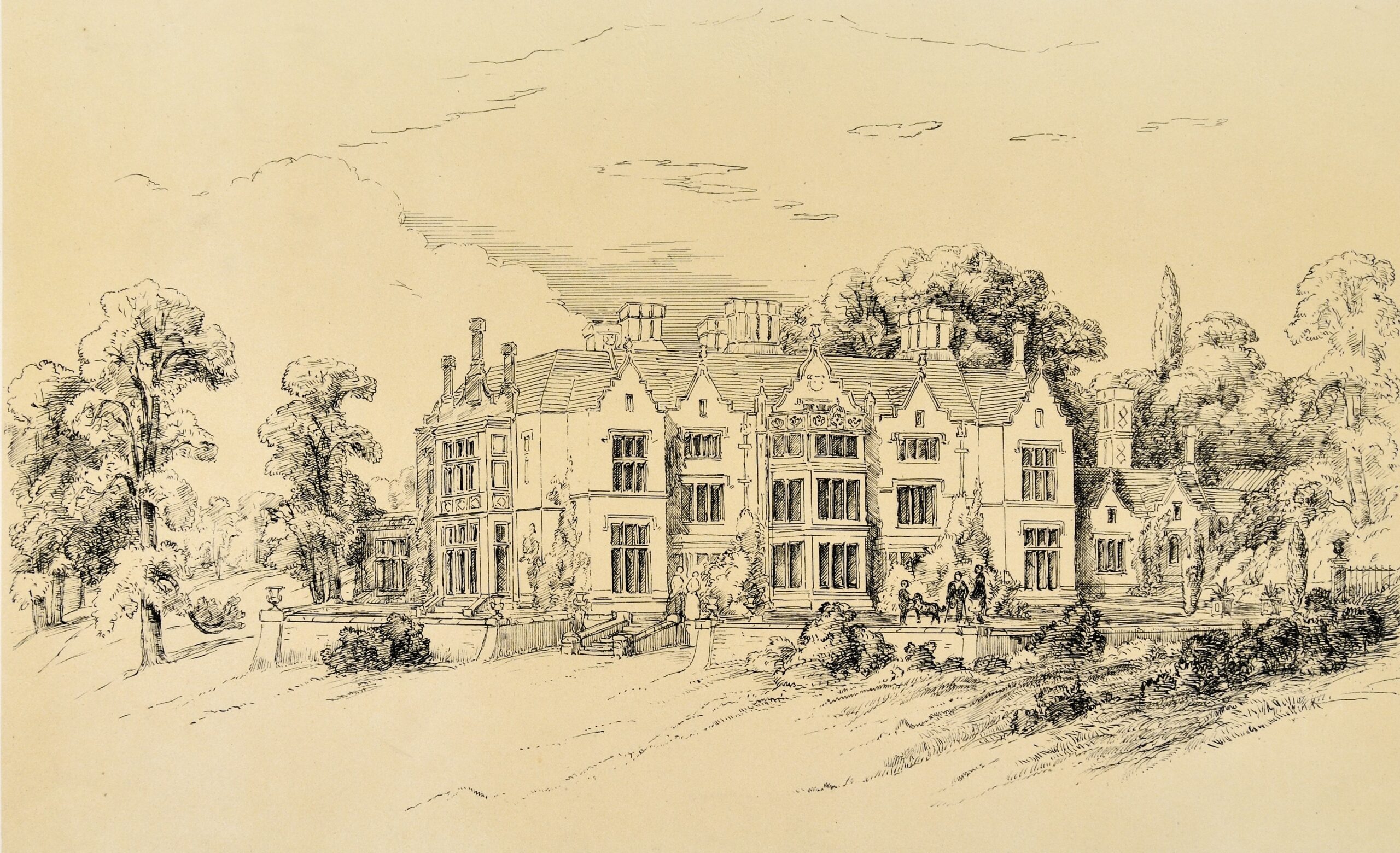
Drawing of Embley Park by Parthenope Nightingale. FNM 0002.
William paid £125,000 for the purchase of the 4000-acre estate (equivalent to over £15 million today). The estate included several lakes, wood plantations, cottages, farms & a manor house. It was estimated that the estate cost a significant £7000 per year to run (£800,000 equivalent today).
Embley Park was known, at the time, to be one of the finest estates in the country, as it was suited for country sporting pursuits. The Lea Hurst property was described as ‘cosy & snug’; Embley Park in contrast was grand & stately, well placed to facilitate serious entertaining.
The Embley Park estate origins can be traced back over 1000 years, The word ‘embley’ meaning ‘a clearing in the woods or elm clearing’ in Old English.
The estate is noted in the Domesday Book of 1086 and initially was owned by the nearby Romsey Abbey before centuries of ownership by notable local families. The core central manor house is of Tudor/Elizabethan style in red brick and was built in 1622. It is characterised on the ground floor by two large halls, divided by an impressive oak staircase that is still in existence to this day.
Florence and her sister Parthenope received a comprehensive education coordinated and delivered by their father. This included mathematics, history, philosophy, classical & modern languages. This was supported by an extensive home library and visits to Embley Park from notable academics. Parthenope, a talented artist documented in sketches, the changing face of Embley Park as it was extended.
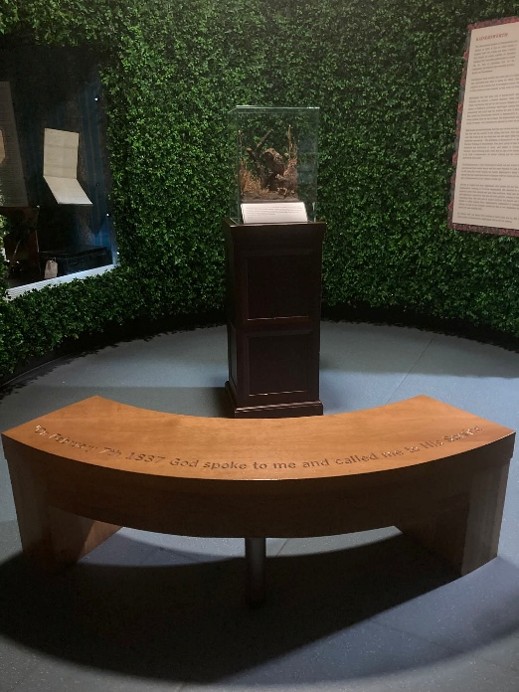
Bench in the Florence Nightingale Museum carved from wood from trees on the Embley Park estate
Significantly, it was at Embley Park, whilst sitting beneath a Lebanon cedar tree on 7th February 1837, that Florence, aged sixteen, experienced what she described as a divine calling from God, calling her to his service. This spiritual turning point ultimately led Florence to her pioneering work in nursing in the Crimea & beyond. It is thought Florence did not reveal this visitation to anyone until much later in 1867.
William Nightingale set about extending & remodelling the house at Embley from 1837-39. He created new three-storey east and west wings, a porch on the north side, a balcony that extended nearly the full length of the house front and a formal south terrace. The alterations reflected Victorian taste and fashion, but Embley was not just a family home; it highlighted the Nightingale’s prominent status within the local & wider community. William Nightingale became a local magistrate and High Sheriff for the county of Hampshire.
The Nightingales were part of the nineteenth century liberal intelligentsia and facilitated gatherings for the intellectual, social, military & political elite of the time at Embley Park. This included Lord Palmerston, the first Liberal prime minister & significantly PM during the Crimean War, who was a nearby neighbour at the Broadlands estate.
The Nightingales also developed the Wild Gardens at Embley, devising long and short walks stocked with rare plant species and carried out extensive tree planting. The gardens contain a stone bench known as ‘Cromwell’s Seat’ moved from Hursley Park near Winchester. The bench is believed to have belonged to Richard, son of Oliver Cromwell, who was leader of the parliamentarian army in the English Civil War and served as Lord Protector of the English Commonwealth following the war.
Florence demonstrated an eager interest and aptitude in the organisation of household affairs. Ten to fifteen full time employed servants were required to ensure smooth running of the estate and house. Florence maintained meticulous lists, helped to recruit junior servants, chose and coordinated furniture and fittings. This presumably put Florence in good stead for organising the necessary logistics to support nursing care in the Crimea.
On return from the Crimea in 1856 and when her health permitted her to, visits to the estate at Embley Park gave Florence a familiar and reflective space in which to both recover from the effects of war and prepare for her post war initiatives including formation of the Nightingale School of Nursing and widespread health and sanitary reforms.
Florence’s sister Parthenope married Sir Harry Verney on 23rd June 1858 at East Wellow Church on the estate.
Later in life Parthenope, portrayed a very picturesque portrayal of Embley:
“Embley in Hampshire was a large picturesque gabled house whose handsome rooms gave ample space for its owners wide hospitality. Soil & climate alike favoured a luxuriant vegetation, it was embowered in flowers and the rhododendrons & azaleas which clothed the plantations with a glow of colour in the spring & early summer gave place to roses & lilies and a procession of blooms lasting far into the winter. Embley was furnished with all that refined and cultivated taste could suggest. Greek & Italian marbles, delicate watercolour drawings, draperies of rich colour, but beyond & above all else the house abounded in books. Old books in their staid brown bindings, foreign classics in white parchment, great folios & portfolios of choice engravings, formed a pleasant background while the best books of the day on all conceivable subjects were heaped on every ledge or coign of vantage. It was a joke against Mr Nightingale to the end of his life that he could not get through a meal without covering the tablecloth with literature. It was a house from which all sordid cares & pecuniary anxieties were excluded & from which sympathy & help flowed bountifully to the poorer homes around it”
The Nightingale family retained ownership of the Embley Park estate until 1895. William and Fanny oversaw its management until their deaths; William in 1874 and Fanny in 1880. Both were buried in the family grave at St Margarets Church in East Wellow. Parthenope died on Florence’s seventieth birthday, May 12th 1890.
Florence died at her home in South Street in London’s Mayfair district on 13th August 1910 and as per her specific wishes she had a very private burial at St Margaret’s Church, alongside her parents.
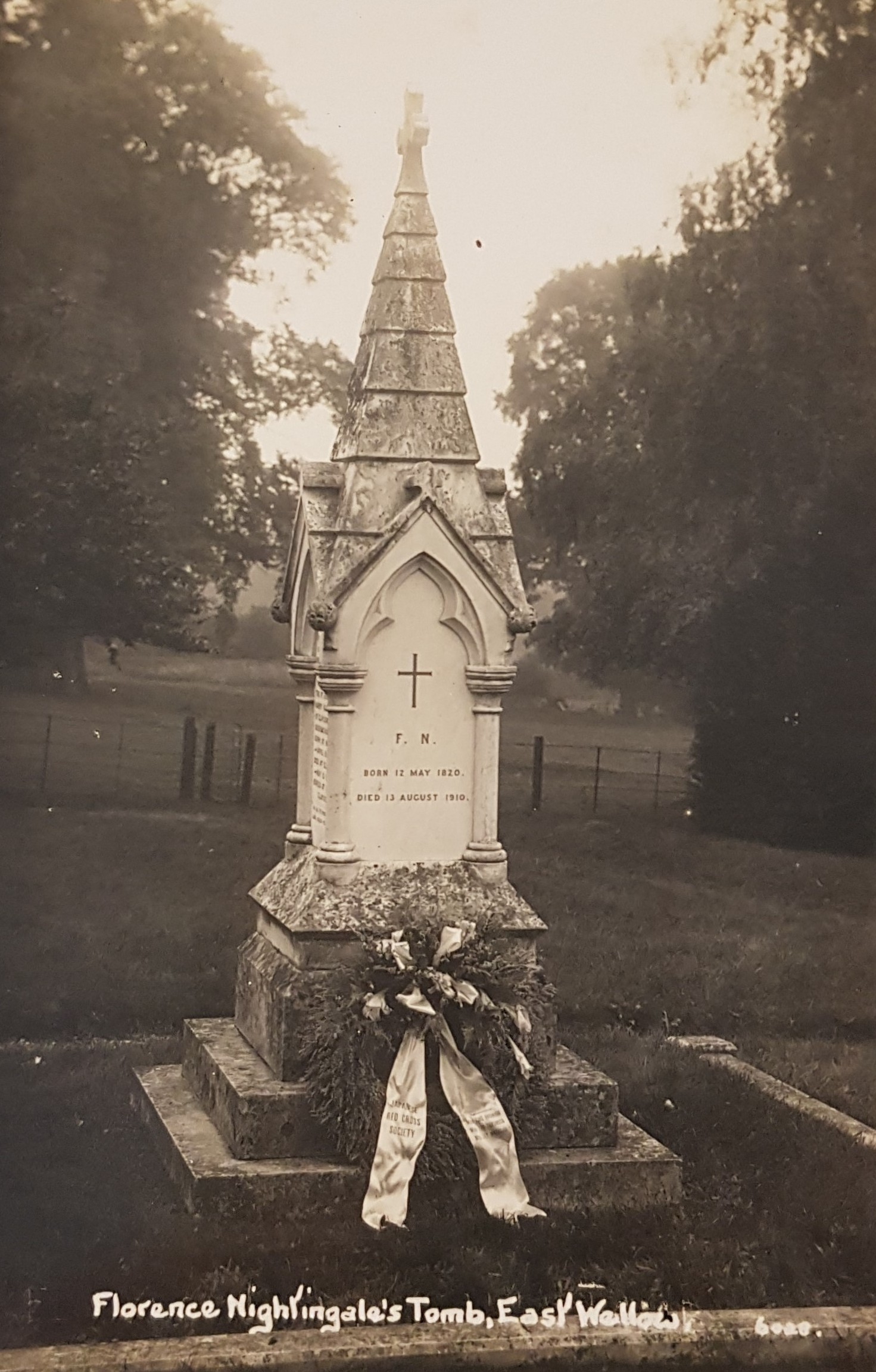
Photograph of Nightingale’s grave marker. FNM 0809.08.
Sarah remembers her own visits to Embley Park and Nightingale’s grave in her childhood:
In the early 1980s, as a school sixth former, my peers and I were taken by minibus from our school in Southampton, to school disco nights at Embley Park School. I can still recall the impressive oak staircase and paneling. My parents also took me, as a child, on several educational visits to the grave of Florence Nightingale & her family at East Wellow.