
The Life and Stoves of Alexis Soyer
Kate Williams, FNM Volunteer, 12th March 2026
The Soyer stove in the Museums’s collection tells the story of Alexis Soyer. Like Florence Nightingale and Mary Seacole, saved lives behind the lines during the Crimean War.
In January 1855, in the depths of the first terrible winter of the Crimean War, a soldier wrote to The Times. He described, with astonishing good humour, the monotonous and inadequate rations “I am afraid if the issue of pork goes on much longer I shall begin to grunt”. He proposed the famous chef, Alexis Soyer, might provide “a receipt or two of how to concoct into a palatable shape the eternal ration… issued to us” [1]. It is possible that he did not expect his suggestion to be taken quite literally.
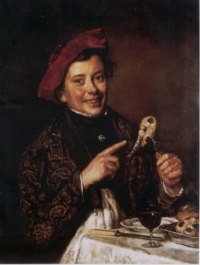
Alexis Soyer was a talented and flamboyant French chef, from humble origins, who worked in the homes of the English aristocracy, and for 10 years was head chef at the Reform Club in London [2] [3], where he met politicians and army officers, singing for them after dinner. The Club’s website still pays tribute to him for setting their tradition of excellence in cuisine “The Reform Club has always paid attention to the quality of its cuisine in the tradition of its celebrated Victorian chef Alexis Soyer. Soyer’s spirit of innovation and excellence continues in today’s kitchen” [4] . He was celebrated during his lifetime not only for his imaginative and lavish cookery, but also for his recipe books, and his ingenious designs for cooking equipment. He was among the first to use piped gas as a cooking fuel in the newly-designed kitchen at the Reform Club. He improved efficiency in kitchens, through better design of the space, and better staff management working systems.
He worked energetically to disseminate his recipes and culinary inventions, to the kitchens of the “higher class of epicures”, and the “easy middle classes” [5]. He patented and sold sauces and cooking utensils, wrote books of recipes, and gave cookery demonstrations. Perhaps remembering his own childhood poverty, he also sought to help the poor and disadvantaged. During the Irish Potato Famine of the 1840s, he took a portable soup kitchen of his own design to Dublin, to help feed the starving people there, and used a similar one to help struggling families in Spitalfields, a deprived area of East London [6]. This experience was useful when he went to improve the food for soldiers on the battlefields and in the hospitals of the Crimean War.
Soyer responded to the anonymous soldier by writing himself to The Times, to respond to the soldier’s letter, committing not only to produce recipes, but to travel to the Crimea to help [7]. He quickly investigated the types of food and the cooking equipment available to soldiers in the field. He experimented himself, and in less than a week produced a book of recipes Camp Receipts for The Army in the East [8].
From discussions with senior military and War Office staff in London he found that the army issued the troops with very limited amounts and variety of foods. The standard rations issued to a soldier in the field were one pound of meat and one pound of bread daily, with 2 pints of tea and half a pint of porter [9],[10], [11]. There was an expectation that the officers would obtain fresh foods locally, but in the severe Crimean winter, soon nothing was available. Soldiers had to cook in open kettles, which were old, too small, inefficient, and even dangerous, as the worn metal surfaces leached toxic substances into the food [12]. The kettle was heated over an open fire, using whatever scraps of fuel could be found. Fires were erratic, and often put out by rain or wind [13]. The smoke they produced gave away their position to the enemy. Soldiers each tried to get the best piece of meat, and to make sure they kept it. They tied their meat ration in string, tagged it with an identifiable marker, such as a button, and put it in the kettle of boiling water. This uncontrollable process produced very badly cooked meat, and was inefficient with fuel. Because of terrible failures of supply and distribution, soldiers were often on half rations, almost entirely salt meat, with hard biscuit replacing fresh bread [14]. Many suffered malnutrition, making them weak and vulnerable to disease.
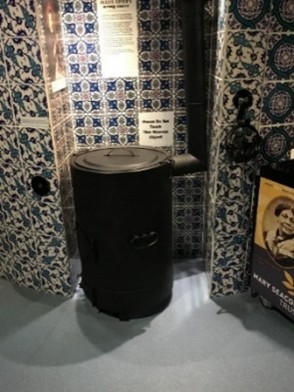 Soyer carefully considered the needs of soldiers in the field, and the sick and wounded in hospitals [15]. He recognised fundamental needs for better food, better cooking equipment, and training in cookery. He followed up the recipe book by inventing a stove for use on battlefields and in field hospitals. He quickly had a scale model built, and used it to convince Lord Panmure, Secretary of War, to order hundreds of them for delivery to the Army in the Crimea. Soyer insisted on going ahead of them himself, with boxes of his recipe books, to support Nightingale’s efforts to improve conditions for the army by managing the planning, preparation and distribution of food, and providing training. He set off for the Crimea within a few weeks of the soldier’s plea, in March 1855 [16].
His field stove solved many problems. The design was an iron cylinder, with a hinged, tightly-fitting lid and a fire at the bottom. The enclosed fire greatly improved fuel efficiency, and could use wood, coal, or other locally available fuel. Soyer calculated that it would save an army of 40,000 men 90 tons of fuel per day [17], a massive saving of around 90% [18]. A door opened low down at the front of the stove to allow fuel to be added, and a valve could be adjusted to control air intake to regulate the rate of cooking, dramatically improving the quality of the food. Smoke was vented by a capped chimney at the back. It produced so much less smoke than open fires that it could be used inside tents, also providing welcome warmth, and was much less visible to the enemy. The lid prevented loss of heat and steam. As the fire was protected from the weather, it allowed food to be cooked outside, even in the rain [19].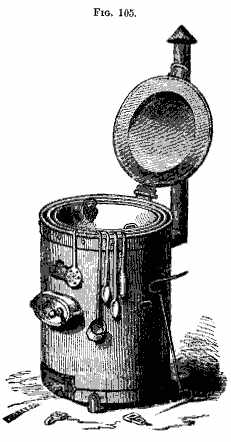
A deep cooking pot fitted into the stove, so was heated at the bottom and sides by the fire [20]. It could be used to cook the salt meat, and also soups, stews, tea, coffee, and cocoa [21]. The pot was fitted with metal loops, to be lifted out with hooks. For baking bread and biscuits, roasting and steaming, a removeable cooking plate could be inserted, instead of the pot, and accessed by a door in the front of the stove. These parts were easily removed for cleaning. A 12 gallon (about 55 litre) capacity size for use in field camps weighed around 40 kg, and could feed a company of 50-60 soldiers [22]. It had carrying handles, and could be dismantled for transport. One could be strapped to each side of a pack horse or donkey [23]. Although Soyer accompanied delivery of the stoves to the battlefield camps to provide training, they were so simple to use that if they arrived before him, soldiers were able to use them without instruction. Soyer trained one soldier in each regiment to cook food for all of them, further improving the quality of the food, and allowing fairer distribution.
Although rapidly becoming ill after arriving at Scutari [24], Soyer quickly set to work with Florence Nightingale to improve the production and distribution of food to patients at the military hospitals [25]. Like her, he struggled to overcome problems with the Army’s appalling supply and distribution systems, and rigid bureaucracy, though this might have been a little easier for him, as he was acquainted with many of the senior soldiers and administrators, and as a man could easily join their social circle. He was gradually able to implement more suitable menus and recipes, train permanent teams of kitchen staff, and get equipment repaired, so that hospital patients were provided with better quality food which was safer and more nutritious. Realising that tea was an essential support to morale as well as hydration, he also designed the “Scutari Teapot”, enabling regular provision of hot tea to hospital patients. Nightingale herself recognized this – “there is nothing yet discovered which is a substitute to the English patient for his cup of tea” [26]. When he felt confident that his reforms of the hospital kitchens would be sustained, he went to the battle fields to begin work there.
After the Crimean War, Soyer worked with Nightingale to make sure that the reforms he had implemented were not lost. Stoves were distributed to the British Army in barracks in England, and abroad, and the Emperor Napoleon had one installed in the Tuileries Palace [28]. He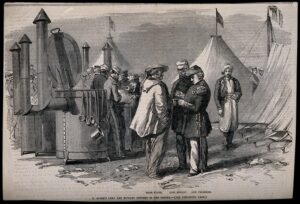 produced recipes for use in military hospitals [29], which became standard issue [30], and a detailed account of his experience in the Crimea, A Culinary Campaign [31], in his characteristic exuberant style. In its preface, he stated that he wanted to use it to promote his further efforts for long-lasting reform of Army Catering. His achievements were recognised and valued. The Morning Chronicle said “He saved as many lives through his kitchens as Florence Nightingale did through her wards” [32].
He was a member of the committee set up to plan future military catering systems, and many of his ideas on equipment, recipes, and training were adopted. He planned a series of lectures to senior military personnel on field cookery, and included samples for tasting [33] [34]. With Nightingale’s support, his design for a model kitchen was installed in the Birdcage Walk barracks, near Buckingham Palace.
His plan for permanent teams of trained military cooks, so that skills and knowledge could be retained and disseminated, continued and gradually evolved. The first Army Catering School opened in Aldershot in 1913 [35], and regimental catering services ultimately became the Army Catering Corps, in 1941 [36].
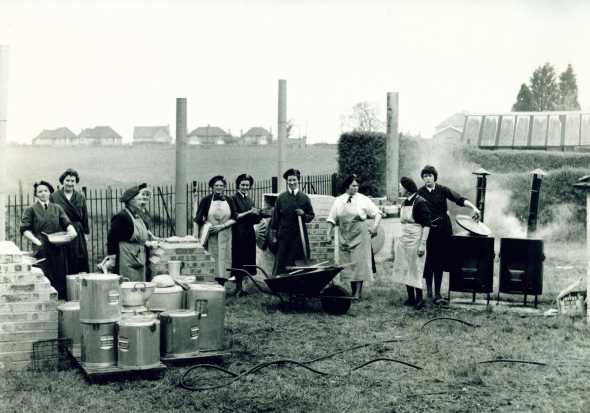 The “ubiquitous soyer (sic) stove” [37] continued in use by the British Army, and organisations providing emergency relief such as the Civil Defence Corps [38], until the later part of the 20th century. A large number were lost when the Atlantic Conveyor supply ship was sunk during the Falklands War in 1982 [39].
Like Nightingale, Soyer became ill in the Crimea. He never fully recovered his health and died less than two years after returning home, at the age of 48. Nightingale recognised his loss to the reform efforts “Soyer’s death is a great disaster. Others have studied cookery… but none but him for the purpose of cooking large quantities of food in the most nutritious and economic manner… He has no successor” [40].
[1] The Times Archive for 16 January 1855, www.thetimes.co.uk/archive/, accessed 08/02/2021
[2] Cowen, R (2006) Relish: The Extraordinary Life of Alexis Soyer Victorian Celebrity Chef Ch 2&3
[3] Volant, R and Warren, JR Memoirs of Alexis Soyer (1859) Kent and Co: London Ch IV et seq. http://books.google.co.uk/books?id=e9xZAAAAcAAJ&printsec=frontcover
[4] The website of the Reform Club www.reformclub.com/Dining, accessed 08/02/21
[5] Soyer, A (1845) A Shilling Cookery for the People Routledge: London 1854 edition www.foodsofengland.co.uk/book1845soyer.htm 31/01/21
[6] Cowen, ibid, Ch 7
[7] Volant suggests he may have been considering this for a while, Volant, ibid, p. 258
[8] Cowen, ibid, Ch 13
[9] Caunt Maj. FA & Capt C J A Jones, 1978 Army Catering Corps The Soldiers Food p 10. Source of original: RLC Museum RLCArchive ref: R0325
[10] Even if the meat contained no bone or gristle (which it did) this ration would amount to approximately 4000 calories, inadequate for a physically active man in very cold conditions.
[11] Cope, Z (1959) Alexis Soyer and the Crimean War Proceedings of the Nutrition Society Alexis Soyer and the Crimean War (cambridge.org), accessed 31/01/21
[12] Cowen, ibid, Ch 13, p. 262
[13] Caunt, ibid p.12
[14] National Army Museum https://www.nam.ac.uk/explore/army-marches-its-stomach accessed 04/02/21
[15] Soyer, A (1857) A Culinary Campaign Routledge: London
[16] Soyer, A (1857) ibid Ch 5
[17] National Army Museum online collection httpsS://collection.nam.ac.uk/detail.php?acc=2002-12-6-1
[18] Forgotten history – Soyer’s Stoves | Calculating (wordpress.com) accessed 04/02/21
[19] Image from https://calculating.wordpress.com/2012/09/21/forgotten-history-soyers-stoves/
[20] Caunt and Jones, ibid, p 13
[21] Caunt and Jones, ibid p 13
[22] Soyer (1857) ibid p 46
[23] Soyer (1857) ibid p 137
[24] Volant, ibid, p 261
[25] Volant, ibid, p 265
[26] Nightingale, F (1860) Notes on Nursing
[27] Image from the Welcome Collection. https://wellcomecollection.org/works/szbqdehw/images?id=dujwxcpz&resultPosition=2
[28] Volant, ibid, p 267
[29] Soyer, A and Warriner, G (1858) Instructions for Military Hospital Cooks on the Preparation of Diets for Sick Soldiers
[30] Cowen, ibid, p 317
[31] Soyer, A (1857) Ibid.
[32] A number of web sites, including website of the Royal Logistics Corps Museum quote this, but I have not been able to find an exact date, it may be from their obituary of Soyer.
[33] Volant, ibid, p 272
[34] Cowen, ibid, p 316-318
[35] History of the Army Catering Corps, National Army Museum www.nam.ac.uk/explore/army-catering-corps
[36] Website of the Royal Engineers Healthful and Sanitary Receipts or 50 Ways to Boil Food (royalengineers.ca)
[37] Creese, R (1982) A Field Hospital at Farnborough Air Show 1980 J R Army Med Corps 128: 37-40
[38] Photograph at https://calculating.wordpress.com/2012/09/21/forgotten-history-soyers-stoves/
[39] Website of the Royal Logistics Corps Museum. The Royal Logistics Corps now has responsibility for Army catering https://www.military-history.org/museum-profiles/royal-logistic-corps-museum-surrey.htm
[40] Cowen, ibid, p 321