Brookwood Cemetery and the St Thomas’ Hospital Connection
Laura Sharpe, Director and Hannah Amos, Perseverance Curator
July 2026
Throughout the history of London, residents were buried in local parish churchyards. As the population of London grew and the city expanded, cemeteries were filling up very quickly and by the 19th century, most were at capacity. Overuse of churchyards led to contamination of local water supplies and multiple uses of individual grave sites, especially where graves were unmarked.
To alleviate this situation the government decided to create several larger cemeteries in sub-urban areas. Seven cemeteries were created in total as part of the Burials Act 1832. This also led to other schemes and businesses being created to provide further space for burials. This included cemeteries such as Highgate, West Norwood and Kensal Green.
One such business was the London Necropolis Railway, which was founded in 1849. The railway company obtained an Act of Parliament to set up the company and to purchase a large expanse of land near Woking, in Surrey, to the south of London [1]. Here they set up Woking Necropolis, which opened to the public in 1854. It was later renamed Brookwood Cemetery. At the time of opening, it was the largest cemetery in the world [2] [3].
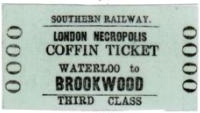
Third class coffin ticket, dating from the 1920s. Credit: Iridescent via Wikicommons.

In order to transport the deceased and mourners, the company built a railway line that led directly to the cemetery from a private station off the side of Waterloo station. The trains would have different sections for the deceased and for other passengers. Each section had different classes of carriages too. The very wealthy would therefore be able to travel in comfort and style which the poorer members of society had a more basic way of travelling.
There were two stations; North served the non-conformist section of the cemetery, while South served the Anglican section [3].
The London Necropolis Railway continued working through to 1941, when the railway was hit by a bomb during the Second World War. This caused major damage to the waiting room and rolling stock, so trains were ceased immediately. Operations had already begun to slow down prior to the bombing though, demand for burials at Brookwood Cemetery had begun to slow, this was in no small part to more people choosing cremation over burials. The Necropolis Railways had stopped their regular timetable and once the war had ended the company decided to close [4].
The old headquarters of the Necropolis Railway are located just around the corner from the Florence Nightingale Museum, on Westminster Bridge Road.

The damage to the London Necropolis Railway, 1941. Credit: Fæ via Wikimedia Commons

Brookwood Cemetery and St Thomas’ Hospital
In 1858, St Thomas’ Hospital signed a contract with the London Necropolis Company to have a dedicated plot. Many patients were referred to as ‘unclaimed’ meaning they did not have family or loved ones in a position to arrange burial for them. By having a dedicated plot, the hospital was able to ensure all deceased patients had a final resting place. Whilst these pauper’s graves were unmarked, extensive paperwork was kept on all who were buried there to ensure they were not lost to history. Records included names, ages, dates of death and burial and the coordinates and depth of each plot.
In 1917, The Governors of St Thomas’ Hospital acquired a second plot at Brookwood Cemetery, plot 46, adjacent to the larger patient’s plot. This plot had space for up 100 graves and was dedicated as the final resting place for staff of the Hospital. Unlike the patients plot this one included headstones and grave markers.
At this time Dame Alicia Lloyd Still was Matron of St Thomas’ Hospital and Superintendent of the Nightingale Training School, she was active in ensuring space would be available for Nightingale Nurses within this plot. [5] Nurses had dedicated their lives to their profession; marriage was not permitted among Nightingale Nurses until the early 1960s so those that had lifelong careers did not have direct descendants and instead found real camaraderie among fellow Nurses, caring for one another. This is reflected in Lloyd Still’s development of the Nightingale Fellowship, an alumni association that “should be a bond of fellowship between past, present and future students of the school”. [6] The fellowship remained active until 2025 and was a way to socialise and support one another but also offered a benevolent fund to support those members who may be in need. It feels fitting that Lloyd Still’ final resting place was Brookwood, where she would remain among another Nightingale Nurses.
In 2020 the Nightingale Fellowship worked with the new management of the cemetery to better acknowledge these plots and since then the site is marked with a sign depicting the Nightingale badge. [6]
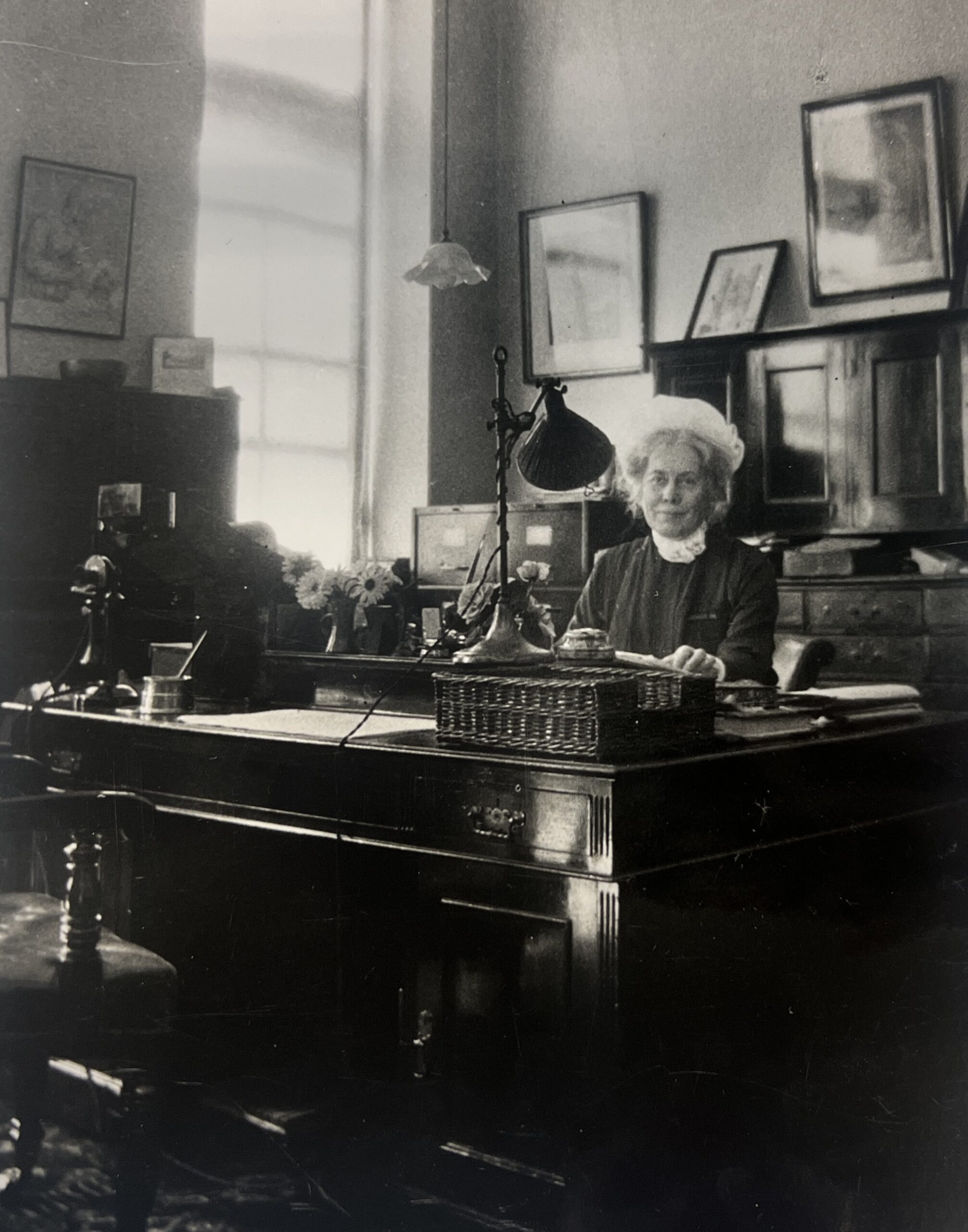
Dame Alicia Lloyd Still at her desk. FNM 1558.01.
23rd July marks the anniversary of the death of Dame Alicia Lloyd still who passed away in 1944, only seven years after her retirement from St Thomas’.
Today, we reflect on her life and legacy that so greatly continued the work that Florence Nightingale had started. Her continued development of the training school and nursing contributed greatly to the profession as a whole.
[1] https://brookwoodcemetery.com/history/
[2] https://livinglondonhistory.com/the-london-necropolis-railway-and-a-visit-to-brookwood-cemetery/
[3] https://www.tbcs.org.uk/about_the_cemetery.html
[4] https://www.southwesternrailway.com/where-next/things-to-do/london-necropolis-railway
[5] Dame Alicia Lloyd Still: A Memoir, Lucy Seymer, Smith & Ebbs Ltd, 1953
[6] The History of the Nightingale Fellowship, Compiled by Carolyn Driver, Valerie Thurtle, Jessica Streeting and Josephine Bonham; John Good Limited, 2025
Suggested reading:
Necropolis: London and It’s Dead by Catharine Arnold, 2006, Simon & Schuster UK Ltd.