Victorian Hair Jewellery at the Florence Nightingale Museum
Hedvig Kovács, FNM Placement Student, 27th April 2026
Hairwork refers to jewellery or artwork made from human hair, a craft most commonly associated with the Victorian era, during which it became a prominent element of the period’s flourishing mourning culture, popularised by Queen Victoria.
The practice, however, predates the Victorian period. A 17th century letter records Mary Verney – of the same Verney family that Parthenope Nightingale married into two centuries later – requesting her husband, Sir Ralph to send her locks of their recently deceased daughter’s hair so that bracelets could be made from them.
Despite its strong association with mourning, hairwork was not exclusively linked to death. Mementos made from a person’s hair were also given to loved ones as sentimental gifts and keepsakes. Queen Victoria reportedly began wearing mementos set with Prince Albert’s hair following their engagement in 1839, and was particularly fond of gifting locks of her own hair to friends and family.
Today, the idea of wearing someone else’s hair as jewellery might seem morbid or unusual, but for Florence Nightingale, the majority of whose life was spent during the Victorian period, it was entirely normal. As a result of that, we hold a number of hairwork objects in our collection, most of which are currently on display and can be seen at the Museum.
One such piece is the bracelet gifted to Florence Nightingale by her cousin, Louis Shore Nightingale. Nightingale wore this bracelet under her sleeve at all times during her time in the Crimea. Crafted from the hair of her father, mother, sister, and cousin, it features a green enamelled heart-shaped pendant and a serpent’s head clasp set with pearls.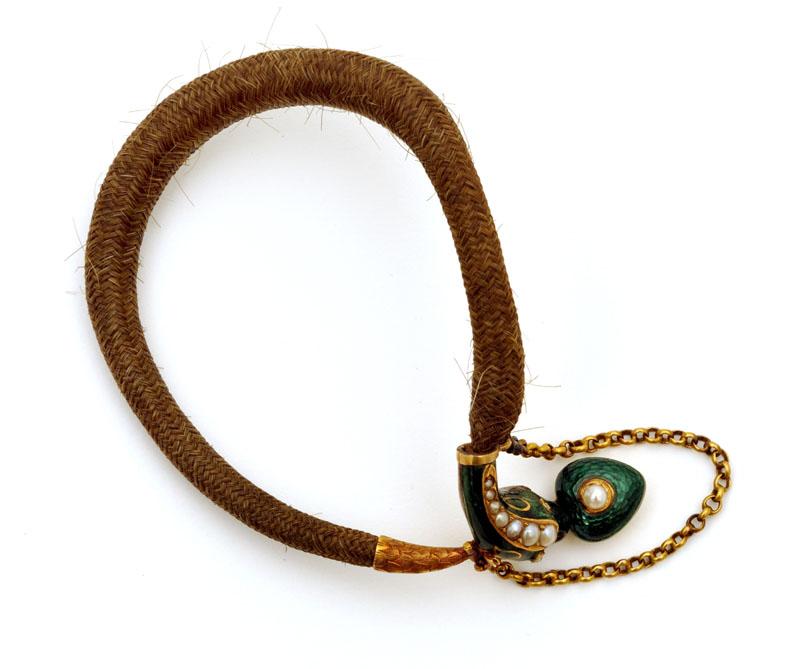
The serpent refers to the ancient symbol of a snake forming a circle by swallowing its own tail, representing eternity, rebirth, and immortality. This was a popular motif of the Victorian era, often featuring in items and architecture associated with mourning and sentimentality, which explains its frequent appearance in Victorian hairwork objects similar to Nightingale’s bracelet. Nevertheless, this bracelet is an excellent example of hairwork being used as a keepsake to remember one’s living friends and family by, and it is easy to imagine Nightingale wearing this piece during the Crimean War as a way to feel closer to her family back home.
The 1864 The Jewellers’ Book of Patterns in Hair Work, published in London by the manufacturing jewellers Halford and Young, showcases the variety of products and designs that can be created from hair, presumably as an advertisement of their own services. As seen on the page below, the serpent motif can be found on multiple designs. Interestingly, illustrations 86, 87, and 94 bear a strong resemblance to the design of Nightingale’s bracelet, underlining the popularity of the design.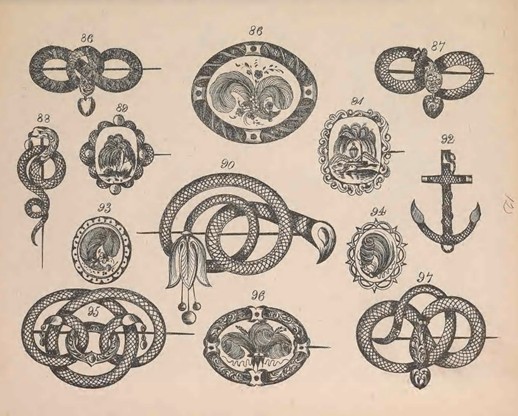
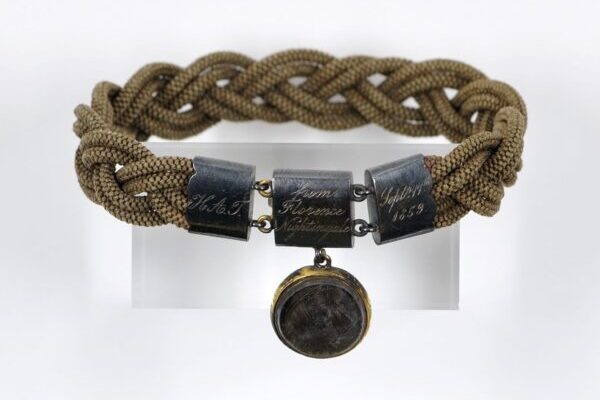
In 1946 the museumreceived a generous donation of another bracelet, containing the hair of Florence Nightingale. This piece was originally gifted by Nightingale to Miss Tilney, a nurse who worked with her in the Crimea, and its gold clasp is engraved with ‘H.A.T. from Florence Nightingale Sept 17th, 1859’.
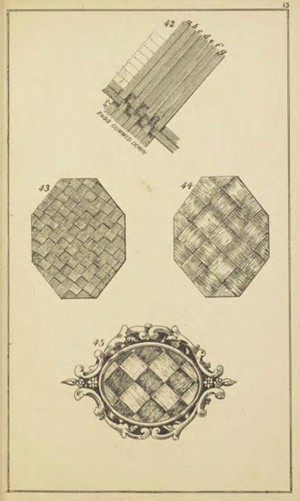
This bracelet is also another excellent example of hairwork being gifted as a keepsake to friends and family as a show of appreciation. The bracelet highlights a different style of hairwork, in which the hair is plaited into a pattern and then enclosed within a locket, similar to the illustrations shown on the photo on the right.
The crafting of hairwork keepsakes and jewelleries became a popular activity for women who could not afford to commission a jeweller. The basket plait pattern present in the bracelet’s locket is one of the easiest designs according to Alexanna Speight’s book The Lock of Hair: Its History, Ancient and Modern, Natural and Artistic.
However it is unlikely that Nightingale made this bracelet herself, due her ability to afford the fees of a craftsman.
While commissioning a jeweller certainly had its advantages, the Victorian clientele was growing suspicious. The sheer volume of work produced at the time brought into question the integrity of the craftsmen as to whether they have kept their commitment to working solely with the locks of hair that was entrusted to them, or if they resorted to working with hair that was sourced cheaply in bulk, making their work easier.
Hairwork may have declined in popularity over the last few decades, but there are still a number of dedicated organisations and individuals working to keep the tradition of this craft alive.